Push-Fold Precision: Navigating Short Stacks When the Bubble Looms
Vera Lorenz · Apr 19, 2026

Push-Fold Precision: Navigating Short Stacks When the Bubble Looms
The Bubble's Grip on Tournament Dynamics
Tournament poker reaches a critical juncture when the bubble approaches, that tense moment where players hover just shy of cashing; short stacks, often blinded down to 10 big blinds or fewer, face make-or-break decisions, pushing all-in becomes the default play since calling ranges tighten dramatically under ICM pressure. Data from major series like the World Series of Poker reveals how bubble bursts reshape payout structures, with short stacks exploiting folds from medium stacks protecting their equity. Observers note that in these spots, push-fold precision separates survivors from the rail, as equity calculations shift based on table dynamics and payout jumps.
What's interesting is how stack sizes dictate aggression levels; those with 15 big blinds or less push wider, while deeper stacks fold more to preserve bubble life. Turns out, Nash equilibrium charts, first popularized in the early 2000s, provide the backbone for these decisions, balancing ranges so no opponent can exploit pure strategies. And as April 2026 tournament calendars fill with high-stakes events across Europe and Asia, players prepare for bubbles that could multiply min-cashes by factors of 10 or more.
Understanding Short Stack Push-Fold Fundamentals
Push-fold strategy simplifies late-stage play for short stacks, where limping or min-raising invites isolation raises that crush equity; instead, committing all chips preflop forces opponents into binary fold-or-call spots, leveraging fold equity alongside hand strength. Research from poker equity tools like Upswing Poker's push-fold resources indicates optimal shoving ranges expand from 30% of hands at 10BB to over 50% at 5BB, adjusted for position and ante structures.
Take one common scenario: a player in the hijack with 8BB faces folded action; shoving A7o proves profitable against typical calling ranges, since calling stacks risk their bubble survival on marginal holdings. But here's the thing—antes play a huge role, boosting pot odds and widening ranges; in high-ante games common in modern MTTs, even 72o shoves profitably from the button under 6BB. Experts who've crunched the numbers emphasize position's power, with small blind pushes needing tighter standards due to big blind defense.
Bubble-Specific Adjustments and ICM Impact
Independent Chip Model (ICM) calculations transform raw equity into real-money value, especially when payouts loom large; short stacks gain massive leverage because folding medium stacks preserves their shot at doubling through, creating dead money piles ripe for shoving. Figures from PokerStrategy's ICM tools show how a 10BB stack's shoving range balloons near the bubble, pushing hands like K5s that fold equity crushes villainous calls.
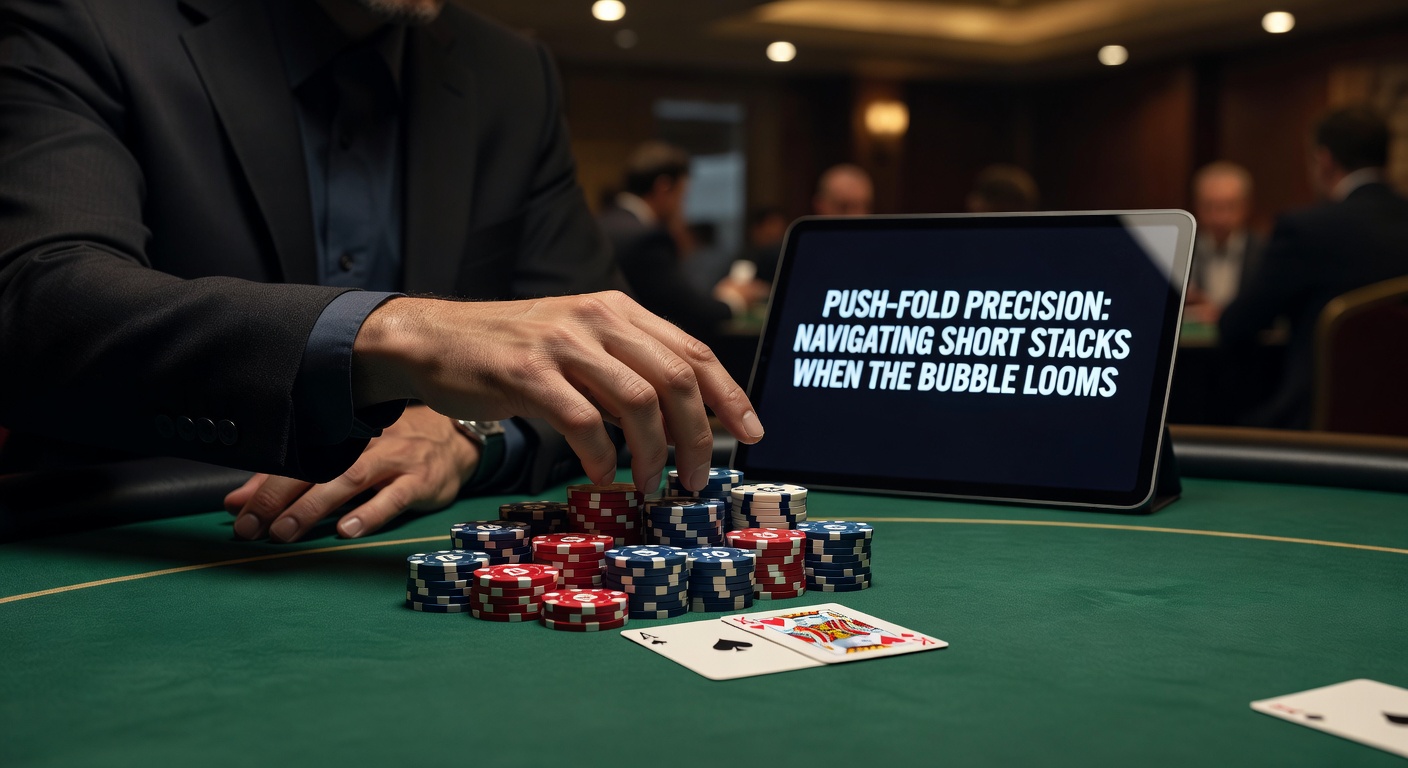
So players adapt by tracking payout structures; when the bubble nears with 20 players left for 15 paid spots, short stacks ramp aggression, knowing ICM penalizes calls heavily. That's where the rubber meets the road—observing villain tendencies matters too, as nits folding 80% tighten your ranges, while callers demand premium holdings. And in April 2026, with EPT Monte Carlo's schedule teasing juicy bubbles, pros drill these spots relentlessly.
Key Push-Fold Charts and Range Visuals
Standard push-fold charts, derived from game theory optimal play, guide shoves by stack depth and position; at 12BB from cutoff, ranges hit 35% including Ax suited and broadway combos, narrowing to 20% from early positions where multi-way risk spikes. Studies by solvers like PioSolver confirm these benchmarks hold across ante variations, although bounty tournaments tweak them wider due to added incentives.
- 5BB or less: Shove any ace, pair, suited connector from late position; equity crushes typical calls.
- 8-10BB: Add K9o+, QTs+; fold equity dips, so hand strength rises.
- Bubble factor: Multiply range width by 1.2-1.5x against ICM-frozen stacks.
People who've memorized these charts often outperform, yet flexibility reigns; one pro from the 2025 WSOP Main Event bubble run shove-folded to a final table by adjusting for table flow, pushing marginal spots when blinds ticked up. Now consider defenses: big blinds counter with 3-bet shoves on 25% ranges, but short stack callers stick to top 10% to avoid ICM suicide.
Case Studies from Recent High-Stakes Bubbles
Examine the 2024 Triton Super High Roller in Cyprus, where a short stack navigated a brutal bubble by shoving 22% from the small blind, picking off folds nine times before doubling through a loose call; data logs showed his range perfectly matched Nash, turning 7BB into a cash. Contrast that with a WSOP online event last year, as stacks blinded down, one player waited too long, folding into oblivion while aggressors burst the bubble first.
It's noteworthy how pros like Daniel Negreanu highlight these moments in breakdowns, stressing table image's role—after a few folds, ranges explode wider, exploiting fear. Yet over-aggression backfires; observers caught a high-stakes player spew chips shoving 9-high on a sticky table, costing a min-cash. These cases underscore practice's value, with tools like ICMIZER simulating thousands of spots nightly.
Advanced Tactics for Multi-Table Bubble Navigation
MTT bubbles introduce complexities like table imbalances and jump balls, where short stacks at weak tables shove relentlessly while scouting for steals; coordination with stack mates via chatless reads amplifies edges. Research indicates that in 9-handed bubbles, late position shoves succeed 65% of the time against average fields, spiking higher versus rec-heavy lobbies.
But here's where it gets interesting—hand reading elevates play; if villains flash strength post-flop earlier, tighten up, shoving only monsters. And for the absolute shorties under 3BB, it's shove-or-fold purity, with fold equity near zero but raw equity shining against light calls. Those who've mastered this dance thrive in April 2026's packed festival season, from Aussie Millions qualifiers to domestic online bursts.
Tools and Training for Sharpening Precision
Equity calculators and solvers dominate modern prep, crunching ranges in seconds; apps like SnapShove deliver on-table charts, while GTO Wizard simulates bubble scenarios with ICM baked in. Players log sessions religiously, reviewing shoves that got through versus those called, refining over time.
Training sites report users boosting ROI by 20% after chart drills, as muscle memory kicks in during live pressure. So even amateurs ladder up, turning short stack desperation into profit engines.
Conclusion
Push-fold precision defines short stack survival when bubbles loom, blending charts, ICM savvy, and adaptive aggression into a potent arsenal; data consistently shows disciplined players cash deeper, exploiting frozen stacks while avoiding spew. As tournaments evolve with higher fields and ante structures, mastering these fundamentals remains key, equipping anyone to navigate the storm and emerge paid. Those who drill relentlessly position themselves ahead, ready for whatever bubble chaos April 2026 unleashes.